Optify Crystal Blog

Top 5 Ways to Use Your EHR Data to Drive Optical Sales

The frame board keeps business hours. Patient demand and the online catalog next door don’t. The average independent practice loses six figures a year to optical revenue that walked out of the office or never made it through the door[^1]. Most of that loss isn’t a pricing problem. It’s a timing problem: the hours when the practice is closed are the hours the patient is still shopping.

None of the five tactics below requires hiring or new chair time. They work with data you already have — patient records, appointment history, and purchase data already living in Crystal PM.

1. Put your frame board online (and keep it open after 5pm)

A 24/7 browsable catalog of your real inventory does the work your physical frame board can’t. Patients research eyewear outside office hours, and a static “brand logo” page captures none of that intent. Practices that put their actual frames online turn after-hours browsing into a patient who shows up prepared, with favorites already chosen.

The cost of skipping this isn’t theoretical. Every evening that your website shows a generic “we carry these brands” page is an evening the patient kept scrolling somewhere else. Crystal PM practices already have the inventory data — the missing piece is getting it in front of patients between appointments.

2. Let patients pre-shop before the exam

About 80% of patients research eyewear online before an appointment[^2]. When you send them to browse and favorite frames in advance, they spend 15–20% more on average[^3]. The optician spends less time on selection and more time helping the patient land — and the basket is bigger when they leave.

The other thing pre-shopping does, quietly, is shorten dispensing. Patients who arrive with their choices already made avoid spending 45 minutes trying on frames, allowing the optician to assist the next patient sooner.

3. Recover the walkout

Walkouts are the single largest source of leakage in optical revenue. Most practices assume that a patient who browsed and left will never return. But it doesn’t have to be that way. An automated message that features the exact frames the patient viewed pulls a meaningful share of them back, and a handful of recovered moments a week compound fast against a six-figure annual leak.

This is where automation earns its place. The follow-up that nobody on staff has time to send is the one that converts the walkout.

4. Automate the reasons to come back

Additional purchases often come from second pairs and from using FSA dollars before they expire at year-end. Crystal PM already tracks the data that makes this possible — benefit reset dates, contact lens reorder cycles, last exam dates. Messages that fire automatically when a benefit window opens or a reorder is due unlock purchases the practice would otherwise never have prompted. Zero optician effort, real revenue.

The patient also reads these messages as service, not as sales. A timely reminder about benefits they already paid for is a favor.

5. Treat your best patients like a loyalty program would

Loyalty programs are not built to convert strangers. They are built around a simple truth: engaged customers spend more. Walmart+ members spend 31% more in-store and 206% more online than non-members[^4], and adidas adiClub members buy 50% more often at twice the lifetime value of the average customer[^5].

Optical is no different. When a patient spends 15 minutes filtering frames, favoriting styles, and imagining what they want before they walk in, they are no longer a cold shopper. They are engaged. And engaged patients are more likely to buy, more likely to spend more, and easier for your team to convert.

That is the value of online engagement: it turns passive patients into active buyers before they ever reach the optical.


Co-Author: Dave Barton, CEO and Co-Founder, Optify. Prior to Optify, he spent 7 years building an online Direct To Consumer optical brand with industry leading software. He is formerly of Oliver Peoples and Paul Smith Spectacles. He draws on over a decade making eyewear for the best brands in the world, having traveled across the globe in search of the best materials and style options and is based in Southern California.

About Optify

Optify is the digital optical platform that helps independent practices compete with online eyewear retailers. Built specifically for optometry, Optify puts a practice’s real frame inventory online with 24/7 browsing, virtual try-on, and patient pre-shopping — so patients arrive at their appointment with favorites already chosen. Automated messaging tools handle walkout recovery, benefit reminders, and contact lens reorders without any staff effort. Optify integrates natively with Crystal PM via a daily inventory sync, giving Crystal PM practices a direct path to putting their patient and inventory data to work between visits.

[1]: Industry estimate based on per-practice walkout-revenue analysis, Optify customer data.

[2]: Vision Council, VisionWatch Consumer Research, 2022.

[3]: AOV lift from pre-shop adoption, Optify customer data.

[4]: Numerator, Walmart+ member spending analysis, 2024.

[5]: adidas AG, FY 2022 Investor Relations report.
EHR Growth Blog

Your Optometry EHR Isn’t Just Software. It’s a Growth Lever for Your Practice.

When we started building Crystal 25 years ago, I sat around a table with an optometrist and two other founders. The idea was simple. We wanted to build the practice management system we wished existed. Not the one being sold. The one we needed.

Back then, most practice management software was treated like plumbing. You bought it. You installed it. You complained about it. You replaced it every seven years when something better came along. It was a line item on the expense report. Overhead. A cost of doing business.

We never saw it that way. From the very first version of Crystal, our point of view was this. The system that runs your practice is either making you money, or it is quietly costing you money. There is no neutral ground. And in 25 years of working with optical practices, from solo offices to multi-location groups to enterprise operations, I have watched that play out over and over again.

Today, when I sit down with a practice owner who is evaluating Crystal, the conversation I want to have is not about features. It is about leverage. Where in your practice is software actually pulling its weight? Where is it just keeping the lights on? Here is how I think about it.

It starts at the front door

Patient acquisition is the first place practice owners feel the weight of their software. Usually because their software is not doing anything to help. If a new patient cannot book an appointment online at 9 p.m. on a Sunday, you have already lost some of them. Crystal’s online scheduling through ScheduleYourExam runs 24 hours a day. It plugs into your website. It quietly turns your SEO investment into booked appointments instead of hoping someone calls back during business hours.

That is not a scheduling feature. That is a patient acquisition engine. And once a patient is in the door, the way they experience your practice matters. Digital intake forms. Text reminders. Kiosk check-ins. Streamlined paperwork. These are the things that decide whether they refer their family or write a one-star review. A modern, consistent in-office experience is not a luxury. In a market where the optometrist down the street is a tap away on Google Maps, it is how you build loyalty.

Then it is about getting more out of every patient who walks in

Most practices are leaving money on the table without realizing it. The optical capture rate is lower than it should be. Recalls are inconsistent. Texting is an afterthought. Crystal connects the optical and medical workflows. A patient who comes in for an exam does not quietly walk past the optical without a conversation. Smart recalls and automated follow-ups bring patients back on their cycle. Not whenever they happen to remember. Texting fills the cancellations and gaps that used to mean an empty chair for an hour.

None of this is glamorous. It is the boring math of practice growth: more visits per patient, more revenue per visit, fewer wasted slots. Done well, it is worth more than any single new marketing campaign you could run.

And then it is about running the business like a business

This is where I see the biggest difference between practices that grow and practices that stall. Growth does not come from working harder. It comes from running tighter.

Crystal Payments posts and reconciles in real time. Insurance turnaround is faster. Billing errors drop. You can see, at any moment, what your providers are producing, what your locations are doing, and what your numbers look like. No more waiting for a month-end report from your billing manager.

For multi-location groups, this is the difference between growth and chaos. Centralized scheduling, standard workflows, and consistent reporting are the things that let you open a third or fourth location without doubling your headcount or rebuilding your training program from scratch. And on the optical side, Crystal gives you a clear view of frame performance, turns, and margins. You stop overbuying the styles that do not move. You start making smart purchasing decisions that compound across the group.

When practice owners tell me they are “drowning in spreadsheets,” what they really mean is that their software is not doing the work it should be doing. Real reporting at the provider level, the location level, and the slot level is how you stop guessing and start making decisions on actual data.

The long view: where this is all headed

Here is the part I care about most, 25 years in. The software you choose today decides what your practice can become five and ten years from now.

Crystal was built to scale from one office to many to enterprise without forcing you to start over. The integrations we have built with labs, devices, payments, and communications are designed to reduce vendor sprawl, not add to it. As AI, automation, and patient engagement tools keep reshaping what is possible in optometry, the practices on a modern platform will adopt them quickly. The practices on legacy systems will be stuck watching from the sidelines.

And when a practice owner eventually thinks about an exit, whether that is a sale, a partnership, or a private equity conversation, clean financials, real reporting, and scalable systems are what drive the valuation. I have seen practices walk away from the table with much more value because their books were tight and their data was real. I have also seen deals fall apart because nothing on the back end held up to scrutiny. The infrastructure you build today is the multiple you collect tomorrow.

What we actually do

The thing I tell every new customer is this. We do not sell software. We are not transactional, and we are not a “set it and forget it” vendor. After 25 years and thousands of practices, we have seen the patterns of what works and what does not. Our team brings playbooks, not just product. We onboard with you. We share what we have learned. We stay involved long after the install.

That has been our approach since day one. It is why we built Crystal alongside an optometrist instead of in a vacuum. And it is why, when I talk to practice owners today, I do not talk about software.

I talk about leverage.

Optometry EHR Template Blog

From Double Entry to Done: How Crystal PM Works the Way You Do

Most EHR systems weren’t built for how eye care practices actually operate. Here’s what changes when your workflows are designed around you.

If you’re still free-typing your way through every exam, you’re not alone — and I say that with zero judgment. It’s one of the first things I hear from optometrists and ophthalmologists when we start talking about their EHR setup. I see doctors spending more time at the keyboard than with their patients, not because they want to, but because their software doesn’t match how they actually work.

I spent 15 years as an office manager in an eye care practice before joining Crystal PM. The doctors I worked for had very specific ideas about how they wanted their records done — and I became so relentless about figuring out how to make it happen that our Crystal tech support person eventually told me, “You need to stop calling. You need to learn how to do this yourself.” So I did. I became one of the first people to really learn the customization side of Crystal, and I fell completely in love with it.

When my doctors retired, I called Crystal and told them they needed to hire me. Fourteen years later, here I am. And my passion is still the medical record. Most of the time, the software is not the problem. It is how it was set up. Doctors are great at adapting. They just shouldn’t have to.

The Real Cost of a Non-Customized Optometry EHR

Every minute you spend free-typing in your EHR is time you are not spending with your patient. Multiply that across 20 or 30 patients a day, five days a week, and it adds up quickly. Then there is the mental load — remembering what to document, where it goes, and whether everything is complete before you can send a referral or close a chart.

Most out-of-the-box templates are not built for eye care. A generic EHR template designed for primary care does not reflect how an optometrist or ophthalmologist actually examines a patient. When it does not fit, people work around it. They type more. They stay late. I see it all the time, and it does not have to be that way.

What True EHR Customization Looks Like for Eye Care

At Crystal, we do not believe you should have to change how you practice just to fit your software. The system should match you.

I want to tell you about one of my favorite doctors. I love this man; I’ve eaten lunch with him and his wife. But his medical record? You would hate it. If I’m being honest, I hate it too. It doesn’t matter, though, because he loves it and it works perfectly for him.

Here is what we were working with: he is color blind, so every color in his interface had to be chosen around what he could actually see. He wanted his entire exam to fit on one screen with no scrolling, so I measured his monitor down to the millimeter — his monitor, not mine, because of course they are different sizes. And because he did not want to type at all, we built his entire exam around buttons.

That template took over 100 hours to build. He loves it, he sees patients efficiently, and — his words — his wife got her husband back. He goes home on time now. That is what the right setup can do.

Your setup probably will not take 100 hours. But the point is the same: Crystal can be built around how you see patients, what you need to document, and how you want to move through your day. That is what makes it different.

No Double Entry: From Patient Intake to Referral Letter

Here is the goal: enter it once and be done.

  • Patient intake forms can live on your website, be texted or emailed as a link, or completed in your waiting room. When the patient submits, their information flows directly into the right fields in Crystal. No one on your team has to retype it.
  • Exam templates built specifically for eye care, with calculation buttons and fields that match how you truly examine patients, mean you are documenting in real time, not piecing the visit back together after the patient leaves.
  • Referral and correspondence letters pull directly from the exam. You finish the visit, click a button, and the letter is ready to fax, securely email, or print. The data is already there. You are not touching it again.

From the moment a patient books to the moment you close the chart, you should not be entering the same information twice. That is not just a feature; that is the whole philosophy.

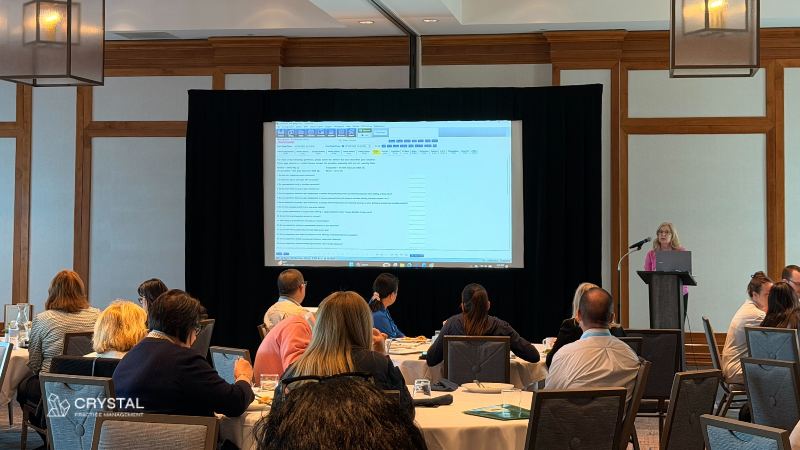
Dion Harmon presenting the power of eyecare EHR customization at NeuroVisual Medicine Institute 2026 Summit.

What’s New and What’s Coming

We have added integrated payments, online scheduling, and two-way patient texting — and what I love about the way we build these things is that they connect to what you are already doing instead of dropping another separate system into your day.

AI-assisted documentation is actively in development, along with a more modern interface. But the focus has not changed. Whatever we build still has to work the way your practice works. That part is non-negotiable.

Where to Start

If you are already using Crystal PM and still free typing your exams, or your intake forms and letters are not connected to your charts, there is a good chance you have a lot of efficiency sitting unused in the software you already own. Most practices are not using Crystal to its full potential — and that is not a criticism, it is just an opportunity.

If you are on a different EHR and any of this sounds familiar — the late nights, the double entry, the template that was clearly built for someone else’s practice — come talk to us. We can show you what it looks like when the system is set up around you, not the other way around.

Less time at the computer. More time with your patients. That is still the goal, and honestly, it is the reason I do this work.

Already a Crystal PM user? Reach out to support and let’s get your templates and workflows set up the way they should be. New to Crystal PM? Schedule a demo and see what it looks like when it’s built around your practice.