
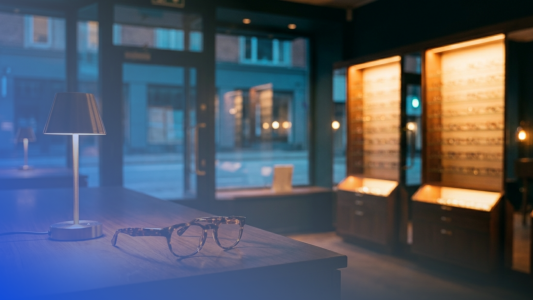
The frame board keeps business hours. Patient demand and the online catalog next door don’t. The average independent practice loses six figures a year to optical revenue that walked out of the office or never made it through the door[^1]. Most of that loss isn’t a pricing problem. It’s a timing problem: the hours when the practice is closed are the hours the patient is still shopping.
None of the five tactics below requires hiring or new chair time. They work with data you already have — patient records, appointment history, and purchase data already living in Crystal PM.
1. Put your frame board online (and keep it open after 5pm)
A 24/7 browsable catalog of your real inventory does the work your physical frame board can’t. Patients research eyewear outside office hours, and a static “brand logo” page captures none of that intent. Practices that put their actual frames online turn after-hours browsing into a patient who shows up prepared, with favorites already chosen.
The cost of skipping this isn’t theoretical. Every evening that your website shows a generic “we carry these brands” page is an evening the patient kept scrolling somewhere else. Crystal PM practices already have the inventory data — the missing piece is getting it in front of patients between appointments.
2. Let patients pre-shop before the exam
About 80% of patients research eyewear online before an appointment[^2]. When you send them to browse and favorite frames in advance, they spend 15–20% more on average[^3]. The optician spends less time on selection and more time helping the patient land — and the basket is bigger when they leave.
The other thing pre-shopping does, quietly, is shorten dispensing. Patients who arrive with their choices already made avoid spending 45 minutes trying on frames, allowing the optician to assist the next patient sooner.
3. Recover the walkout
Walkouts are the single largest source of leakage in optical revenue. Most practices assume that a patient who browsed and left will never return. But it doesn’t have to be that way. An automated message that features the exact frames the patient viewed pulls a meaningful share of them back, and a handful of recovered moments a week compound fast against a six-figure annual leak.
This is where automation earns its place. The follow-up that nobody on staff has time to send is the one that converts the walkout.
4. Automate the reasons to come back
Additional purchases often come from second pairs and from using FSA dollars before they expire at year-end. Crystal PM already tracks the data that makes this possible — benefit reset dates, contact lens reorder cycles, last exam dates. Messages that fire automatically when a benefit window opens or a reorder is due unlock purchases the practice would otherwise never have prompted. Zero optician effort, real revenue.
The patient also reads these messages as service, not as sales. A timely reminder about benefits they already paid for is a favor.
5. Treat your best patients like a loyalty program would
Loyalty programs are not built to convert strangers. They are built around a simple truth: engaged customers spend more. Walmart+ members spend 31% more in-store and 206% more online than non-members[^4], and adidas adiClub members buy 50% more often at twice the lifetime value of the average customer[^5].
Optical is no different. When a patient spends 15 minutes filtering frames, favoriting styles, and imagining what they want before they walk in, they are no longer a cold shopper. They are engaged. And engaged patients are more likely to buy, more likely to spend more, and easier for your team to convert.
That is the value of online engagement: it turns passive patients into active buyers before they ever reach the optical.

Co-Author: Dave Barton, CEO and Co-Founder, Optify. Prior to Optify, he spent 7 years building an online Direct To Consumer optical brand with industry leading software. He is formerly of Oliver Peoples and Paul Smith Spectacles. He draws on over a decade making eyewear for the best brands in the world, having traveled across the globe in search of the best materials and style options and is based in Southern California.
About Optify
Optify is the digital optical platform that helps independent practices compete with online eyewear retailers. Built specifically for optometry, Optify puts a practice’s real frame inventory online with 24/7 browsing, virtual try-on, and patient pre-shopping — so patients arrive at their appointment with favorites already chosen. Automated messaging tools handle walkout recovery, benefit reminders, and contact lens reorders without any staff effort. Optify integrates natively with Crystal PM via a daily inventory sync, giving Crystal PM practices a direct path to putting their patient and inventory data to work between visits.
[1]: Industry estimate based on per-practice walkout-revenue analysis, Optify customer data.
[2]: Vision Council, VisionWatch Consumer Research, 2022.
[3]: AOV lift from pre-shop adoption, Optify customer data.
[4]: Numerator, Walmart+ member spending analysis, 2024.
[5]: adidas AG, FY 2022 Investor Relations report.